


You bought a machine that grinds fresh beans on demand, so the beans you feed it matter more than they would with a pod or a filter machine. Get it wrong, in a Magnifica, a Dinamica, a Primadonna, or on the portafilter of a La Specialista, and you're the one paying for it: in clogs, in flat shots, in a machine that stops doing what you paid for.
TL;DR
- Skip oily, dark-roast beans. The shine on the outside means oil that ends up coating your grinder and brew unit.
- Medium roast, dry surface. The safest zone for any Delonghi, bean-to-cup or La Specialista.
- Arabica or a solid blend. Easier on the burrs, more going on in the cup.
- Bean-to-cup vs. La Specialista aren't the same machine. One has a sealed brew group, the other's a grinder feeding a portafilter you handle yourself.
- Dial in your settings. Even good beans taste flat on factory-default grind and strength.

Why your Delonghi needs the right beans
Bean-to-cup machines like the Magnifica, Dinamica, and Primadonna are a fast-growing part of Europe's home coffee-machine market, and for good reason: press a button, get a fresh-ground shot. But that convenience runs through a grinder and a brew unit that never gets rinsed under the tap. Whatever you pour in the hopper, the machine has to live with it.
Here's the mechanical bit worth understanding. On a Magnifica, Dinamica, Primadonna, Eletta, or Rivelia, beans get ground and dosed straight into a fixed brew unit. Some of these come out for a rinse, most don't fully. Either way, oily residue builds up in a space you can't easily scrub.
The La Specialista works differently. It's a semi-automatic: the grinder doses ground coffee into a portafilter, which you tamp and lock into the group head yourself, same as a café machine. There's no sealed brew unit here, but there is a grinder with burrs that oily beans will gum up over time, along with a dosing chute that clogs the same way.
Different mechanism, same enemy. Oil residue is what shortens the life of both setups.
What to look for in coffee beans for your Delonghi

Roast level: medium is the safe zone
Medium roast is where flavour and machine health line up. A 2024 study published in iScience found dark roast beans build up significantly more electrostatic charge during grinding than light roasts, because of how residual moisture affects charge polarity (Méndez Harper, Bumbaugh & Hendon, iScience, 2024). That charge is exactly why dark roast grounds clump and stick to grinder walls instead of falling cleanly into your cup or portafilter.
Medium roast keeps more oil locked inside the bean, so the grinder stays cleaner and the brew unit picks up less residue. You also get more of what's actually in the bean, fruit, chocolate, caramel, instead of roast bitterness covering it up.
Oil content: if it shines, skip it
Hold a handful of beans up to the light. Matte and slightly rough? Good. Shiny, almost slick? That's oil that's pushed through the bean's cell walls from extended roasting. In a bean-to-cup machine, that oil coats the brew unit and grinder chute. In a La Specialista, it coats the burrs and the dosing funnel first.
Either way, the same researchers behind the electrostatic-charge finding tested a fix: adding 0.01–0.05 mL of water per gram of beans before grinding cut electrostatic charge by 50 to 60%, stopped the clumping, and raised espresso extraction concentration by at least 15% in treated dark roasts (Méndez Harper, Bumbaugh & Hendon, iScience, 2024). That's a lab workaround for a bean that's already fighting your machine. Simpler fix: buy beans that don't need the workaround in the first place.
Origin: Arabica or a decent blend
100% Arabica is the safer default for any Delonghi. The beans are softer, lower in acidity, and easier on grinder burrs over years of daily use, whether that's the Aroma system in a Magnifica or the conical burr grinder feeding a La Specialista's portafilter.
An Arabica-dominant blend with a bit of quality Robusta isn't a problem either. Robusta adds crema and body, which matters if you're chasing café-style shots on the La Specialista. The issue is cheap, Robusta-heavy commodity blends, not Robusta itself.
Processing method: washed or natural, both work
Washed beans give you a cleaner, brighter cup, and they tend to run slightly drier, which is friendly to any grinder. Natural-processed beans (dried with the fruit still on) bring bigger, fruitier flavours, berry, stone fruit, sometimes wine-like notes. We've found naturals can turn oilier than washed beans if pushed into a darker roast, thanks to the residual sugars caramelizing on the surface. Stick to medium and you sidestep that entirely.
What to avoid
Skip anything labelled "Espresso Forte," "Italian Roast," "Extra Dark," or similar. Per the European Coffee Federation's European Coffee Report, Europe is the world's largest coffee-consuming region, and a lot of that volume is commodity-grade, dark-roasted beans designed to taste the same in every bag regardless of origin.
That consistency is a fair trade for a filter machine at home. It's a bad trade for a Delonghi, bean-to-cup or La Specialista, built to extract nuance out of beans that actually have some.
Delonghi settings for better-tasting coffee
Right beans, wrong settings still gets you a flat cup. Delonghi's factory defaults are tuned for generic supermarket coffee, not specialty beans, so plan on adjusting.
Grind size
Go a notch or two finer than the factory default on bean-to-cup models, and dial in similarly on the La Specialista's grinder. Watch the flow: it should come out as a slow, steady stream, not a drip and not a gush. Too fine and it stalls or drips. Too coarse and it rushes through tasting thin.
Adjust the grind dial only while the grinder is actually running, never while it's stopped.
Brew temperature
Push it up for medium and light roasts. Denser, less-roasted beans need more heat to give up their flavour compounds. If you switch to a darker roast at any point, bring the temperature back down to avoid tipping into bitterness.
Coffee strength and dose
Set strength toward the stronger end, roughly 8 or 9 out of the usual 10-point scale, or bump the dose on your La Specialista's portafilter basket. Specialty beans carry more layered flavour than a Robusta-heavy blend, and a thin dose just tastes watery.
La Specialista-specific: tamping and dosing
Because you're handling the puck yourself, consistency is on you. Level the grounds, tamp evenly, and keep your dose within a gram or two each time. An uneven puck channels water unevenly, and you'll get sour and bitter notes in the same shot.
Troubleshooting: when the coffee doesn't taste right
Too sour
That's under-extraction, water moved through too fast.
- Grind one or two steps finer
- Raise the brew temperature
- On a La Specialista, tamp firmer and check your dose isn't too light
Too bitter or burnt
That's over-extraction, or it's an oily-bean problem building up in the machine.
- Grind one step coarser
- Lower the temperature slightly
- Run a cleaning cycle, and check the grinder chute or portafilter basket for oily buildup
Coffee tastes flat or weak
Usually a dosage issue, sometimes it's the beans themselves. Increase the dose, check the grind isn't too coarse, and make sure the beans aren't stale or oxidised from sitting open too long. Fresher beans generally taste more vivid, though that's a smaller factor than roast level and oil content.
Specialty vs. supermarket beans: the real difference for your Delonghi
| Feature | Supermarket beans | Specialty coffee (like Camino) | Impact on your Delonghi |
|---|---|---|---|
| Roast level | Often dark or extra dark | Medium to medium-dark | Dark roast means more oil and more grinder clumping |
| Surface oil | Visible, shiny beans | Minimal, matte beans | Less oil reaching the brew unit or grinder burrs |
| Flavour profile | Bitter, flat, one-note | Fruit, chocolate, caramel, nuts | Actually worth the grind-on-demand mechanism |
| Bean origin | Commodity blend, often Robusta-heavy | Single origin or quality blend | Softer on burrs, whether bean-to-cup or La Specialista |
| Quality scoring | Unscored | 86+ on the SCA scale | Consistent quality in, consistent shots out |
Where Camino fits in
If you're running a Jura instead of a Delonghi, the oil and roast logic is the same, just applied to a different brew mechanism. Our Jura coffee beans guide walks through the fixed-brew-unit side of things in more detail. Own a Philips with LatteGo instead? Same principle again, and worth a read: best coffee beans for Philips LatteGo.
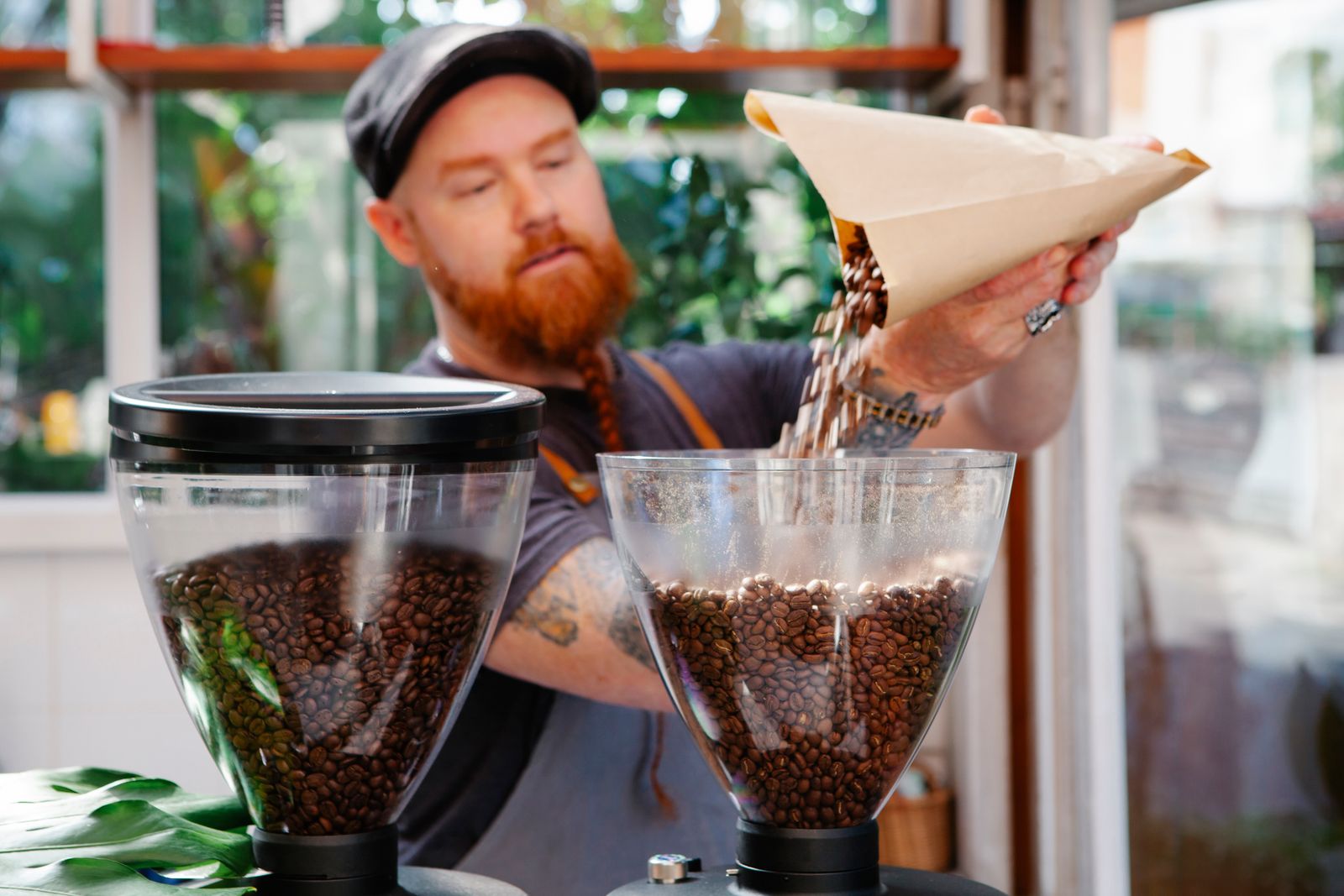
Camino Coffee sources specialty-grade Arabica beans roasted to medium profiles, the zone that works whether you're running a Magnifica, Dinamica, Primadonna, Eletta, Rivelia, or a La Specialista. No oily surface, no dark-roast bitterness masking what's actually in the bag.
If you're not sure where to start, a medium roast with chocolate and caramel notes is the safest, most crowd-pleasing pick for any of these machines. It works for straight espresso, for milk drinks, and for longer cups too.
Frequently asked questions about Delonghi coffee beans
Which coffee beans are best for a Delonghi machine?
Dry, medium-roast beans, either 100% Arabica or an Arabica-dominant blend. Whether you own a Magnifica, Dinamica, Primadonna or a La Specialista, oily dark-roast beans are the main thing to avoid.
Are dark roast beans bad for a Delonghi machine?
Dark roast beans are riskier because they're oilier, and that oil clumps inside the grinder and coats the brew unit. Research shows dark roasts carry a stronger electrostatic charge during grinding, which makes the clumping worse.
Does the La Specialista handle beans differently than the Magnifica or Dinamica?
Yes. Bean-to-cup models like the Magnifica, Dinamica and Primadonna grind straight into a fixed brew unit you can't remove. The La Specialista grinds into a portafilter you tamp and lock in yourself, so oily buildup shows up in the grinder burrs first, not a sealed brew group.
Can I use decaf beans in a Delonghi machine?
Yes, as long as the decaf beans are medium roast and not oily. Specialty-grade decaf works fine in a Magnifica, Dinamica, Primadonna or La Specialista, and won't cause any extra buildup versus regular beans.
Why does my Delonghi coffee taste sour or bitter?
Sour usually means under-extraction: grind finer, raise the temperature, or use a shorter brew setting. Bitter usually means over-extraction or oily bean residue: grind coarser, lower the temperature, and check the brew unit for buildup.
Is Robusta suitable for a Delonghi machine?
Good-quality Robusta can work and adds crema, but it's harder on the grinder burrs than Arabica. Pure Arabica or an Arabica-dominant blend is gentler on both bean-to-cup grinders and the La Specialista's burr grinder.


